
1. Application
4-Nitrophenyl Phosphate (pNPP) is widely used as:
- Substrate for Alkaline Phosphatase (ALP) assays
- Enzyme kinetics studies
- ELISA detection systems (colorimetric substrate)
- Clinical chemistry reagent for ALP estimation
- Molecular biology and biochemical research
- Pharmaceutical quality control laboratories
When hydrolyzed by alkaline phosphatase, pNPP produces 4-nitrophenol, yielding a yellow color measurable at ~405 nm.
2. Compliance Standard
(Depending on grade supplied)
- AR / ACS Grade
- ISO 9001 certified manufacturing
- ISO 13485 (for diagnostic-grade reagents, where applicable)
- USP / EP / BP grade (if specified)
- Suitable for IVD use (for diagnostic grade material)
3. Product Description
4-Nitrophenyl Phosphate is a chromogenic phosphatase substrate, typically supplied as a white to off-white crystalline powder. It is water-soluble (in salt form) and stable when stored under recommended conditions.
Common chemical forms:
- 4-Nitrophenyl Phosphate Disodium Salt Hexahydrate
- Free acid form (less common)
4. Technical Specifications
|
Parameter |
Specification |
|
Chemical Name |
4-Nitrophenyl Phosphate |
|
Synonym |
p-Nitrophenyl Phosphate (pNPP) |
|
Molecular Formula |
C6H4NO6P (free acid) |
|
Molecular Weight |
~219.09 g/mol (free acid) |
|
Appearance |
White to pale yellow crystalline powder |
|
Assay (Purity) |
≥ 98% (AR Grade typical) |
|
Solubility |
Soluble in water (salt form) |
|
Detection Wavelength |
405 nm (after hydrolysis) |
|
Storage |
2–8°C, protected from light |
|
Stability |
Hygroscopic; store tightly closed |
5. Apparatus is Supplied
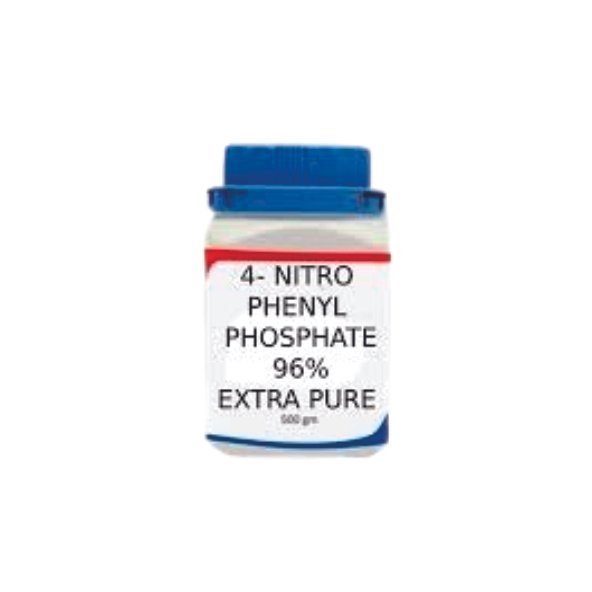
- 4-Nitrophenyl Phosphate (powder form)
- Packed in amber glass bottle or HDPE container
- Supplied with Certificate of Analysis (CoA)
- Properly labeled with batch number and expiry date
6. Optional Accessories
- Alkaline Phosphatase enzyme
- Assay buffers (DEA buffer, Tris buffer)
- Microplates (96-well ELISA plates)
- Spectrophotometer (405 nm capability)
- Micropipettes & tips
- Analytical balance
- Desiccator storage
7. Common Capacities Available
- 1 g
- 5 g
- 10 g
- 25 g
- 50 g
- 100 g
(Custom bulk packing available for industrial/diagnostic manufacturers.)
8. Dimensions & Weight (Approx.)
(Packaging dependent)
|
Pack Size |
Approx. Bottle Height |
Approx. Weight (Gross) |
|
1 g |
50–60 mm |
80–120 g |
|
5 g |
60–80 mm |
120–180 g |
|
25 g |
80–100 mm |
200–350 g |
|
100 g |
100–120 mm |
400–700 g |
9. Safety & Handling
- Avoid inhalation and contact with skin/eyes
- Use PPE (gloves, lab coat, goggles)
- Store in cool, dry place
- Refer to SDS for hazard classification