
Application
Glass pipettes are used for:
- Precise measurement and dispensing of liquids in chemical analyses.
- Preparing standards and reagents in pharmacopeial labs.
- Clinical and diagnostic sample handling.
- Educational laboratory experiments.
- Quality control testing in research and industrial settings.
Compliance Standards
Typical compliance standards (depending on type and class of pipette):
- ISO 648 / EN ISO 648 — Volumetric glassware specification.
- DIN 12696 — Graduated pipette manufacturing standard.
- IS 1117:2018 — Indian standard for single volume pipettes.
- USP / ASTM E-1044 & ASTM E-969 — For USP/ASTM-certified pipettes (Class A).
- Batch or Individual Calibration Certificate — Meets quality traceability requirements.
Product Description
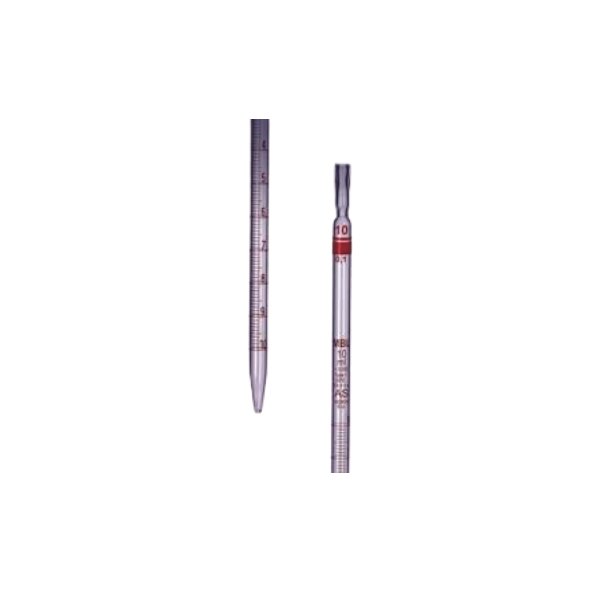
A glass pipette is a calibrated laboratory glassware instrument designed for precise measurement and transfer of liquid volumes. Constructed from high-quality borosilicate or soda-lime glass, the pipette ensures excellent chemical resistance, thermal stability, and optical clarity. It is calibrated “to deliver” (TD, Ex) under standard reference conditions for accurate volumetric work in analytical, pharmaceutical, clinical, and research laboratories.
Technical Specifications :
|
Property |
Typical Values |
|
Material |
Borosilicate 3.3 or high-quality soda-lime glass |
|
Calibration Type |
“To Deliver” (TD, Ex) |
|
Accuracy Class |
Class A / Class AS / Class B (as per ISO/DIN/USP/ASTM) |
|
Calibration Temp |
20 °C reference |
|
Graduation |
Permanent amber or blue enamel markings |
|
Calibration Certificate |
Batch / individual (traceable) |
|
Chemical Resistance |
High resistance to acids, organics, solvents |
|
Thermal Stability |
Autoclavable up to ~121 °C (for some types) |
|
Reference Standards |
ISO 648 / DIN 12696 / IS 1117 / USP/ASTM |
|
Tolerance Example (1 mL) |
±0.02 mL (Class-A typical) |
Apparatus Supplied :
- Glass pipette (as per specified capacity and class).
- Batch calibration certificate or individual certificate (Class A).
- Protective packaging (tube/vial/box).
Optional Accessories
- Rubber bulbs / suction devices.
- Pipette stands.
- Cleaning brushes.
- Individual calibration certificates (USP/DAkkS).
- Protective pipette carriers.
- Autoclave pouches.
Common Capacities Available
Glass pipettes are available in a wide range of calibrated capacities, including:
0.1 mL, 0.2 mL, 0.5 mL, 1 mL, 2 mL, 5 mL, 10 mL, 15 mL, 20 mL, 25 mL, 50 mL, 100 mL* (volumetric or graduated types).
Dimensions & Weight (Approx)
|
Capacity |
Approx Length (mm) |
Approx Weight (g) |
|
1 mL |
~300 |
~15–25 |
|
2 mL |
~320 |
~20–30 |
|
5 mL |
~350–380 |
~30–45 |
|
10 mL |
~400–450 |
~50–70 |
|
25 mL |
~500–550 |
~90–120 |
|
Larger (50–100 mL) |
~600–800 |
~150–300 |
Handling & Safety Notes
- Handle glass pipettes carefully to avoid breakage.
- Use appropriate suction bulbs—never use mouth pipetting.
- Clean with suitable solvents; avoid thermal shock.
- Store in protective racks or padded boxes.