
1. Applications
UV–Vis spectrophotometers are widely used in:
-
Quantitative analysis (Beer–Lambert Law)
-
Pharmaceutical analysis & drug identification
-
DNA/RNA & protein estimation
-
Environmental testing (water quality)
-
Food & beverage quality control
-
Chemical kinetics & reaction monitoring
-
Academic and industrial research
2. Compliance Standards
Typical compliance and regulatory standards:
-
USP (United states Pharmacopeia)
-
EP (European Pharmacopeia)
-
JP (Japanese Pharmacopeia)
-
ISO/IEC 17025 (Calibration standards)
-
21 CFR Part 11 (Data integrity, optional software)
Key performance parameters defined:
-
Wavelength accuracy
-
Photometric accuracy
-
Repeatability
-
Stray light & resolution
3. Product Description
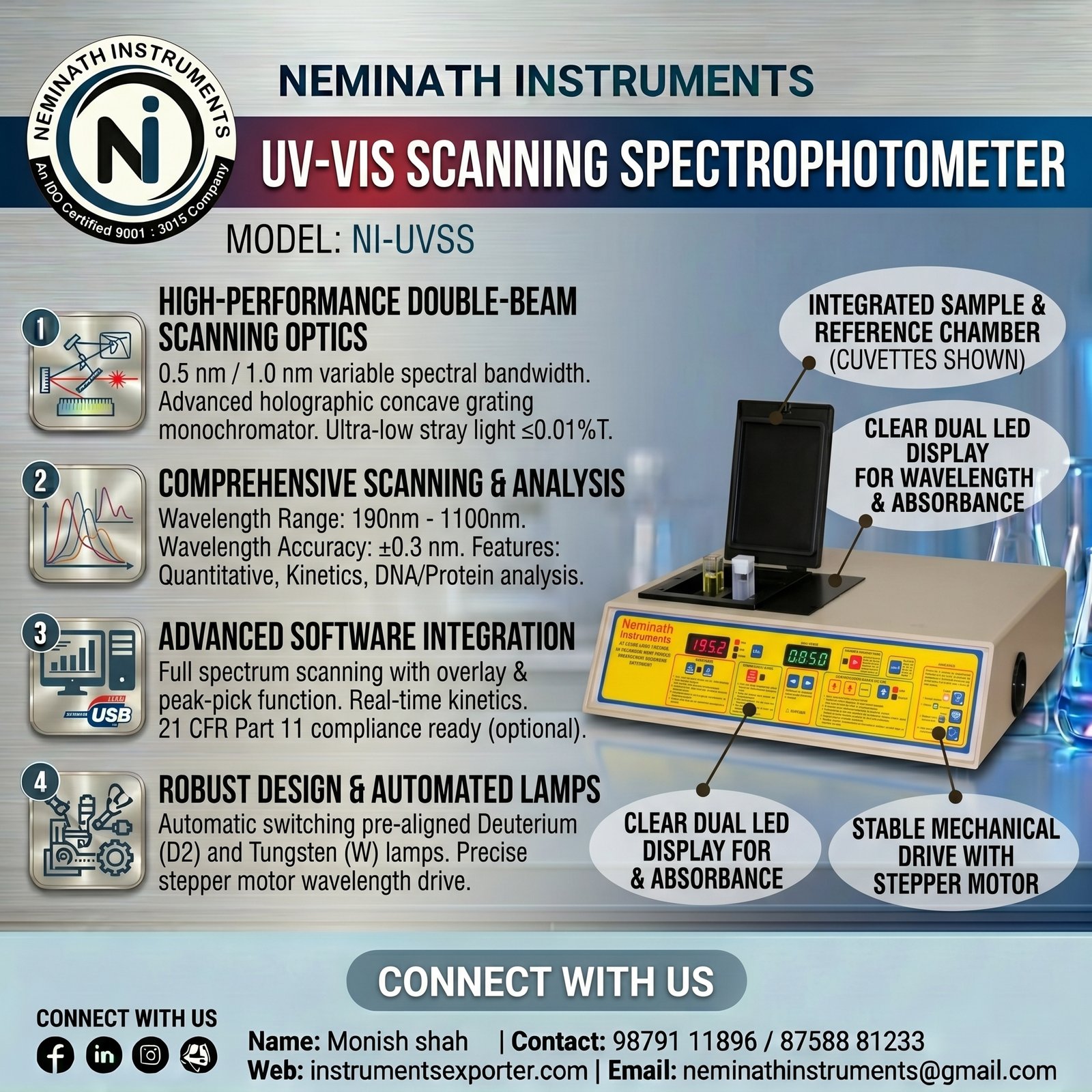
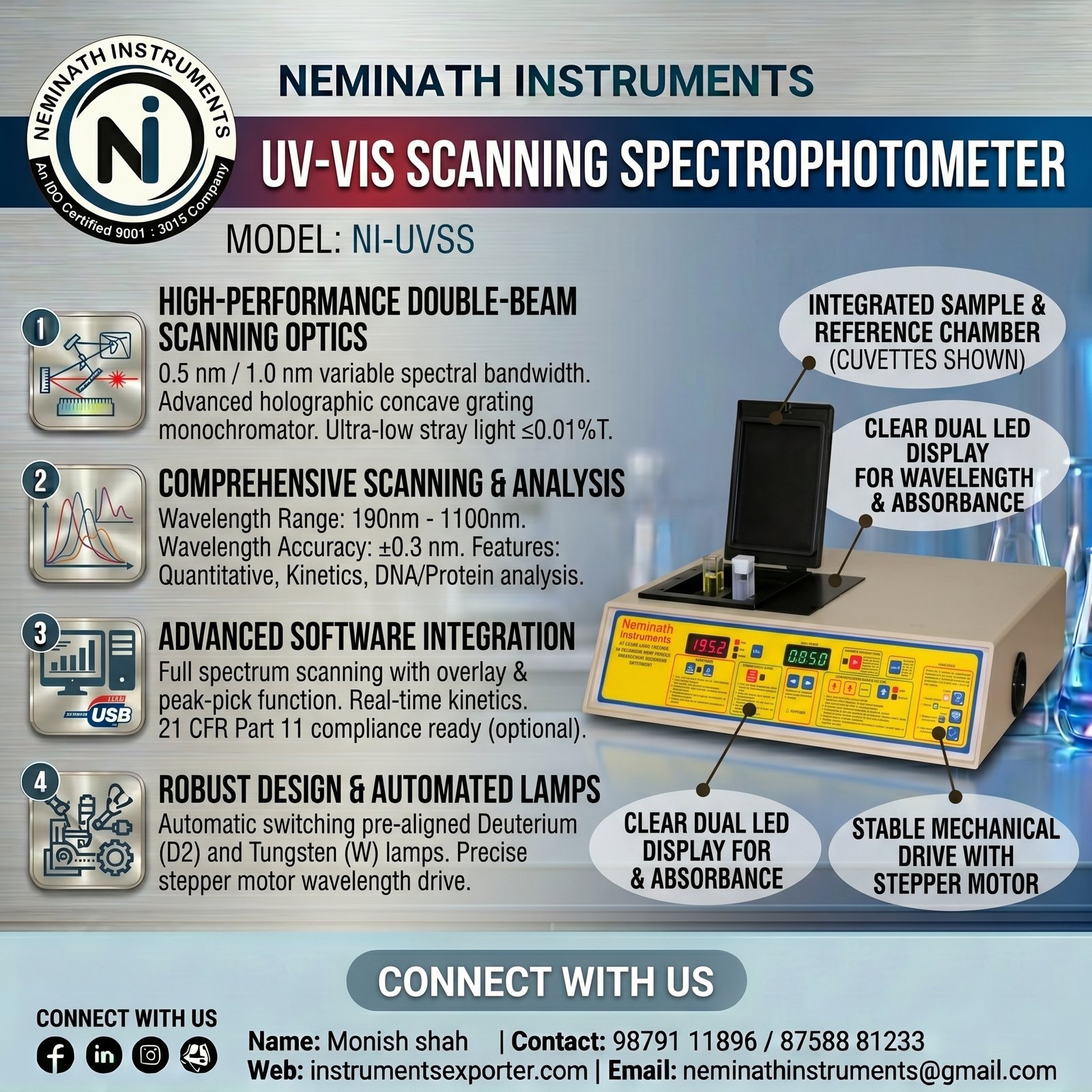
A UV–Vis scanning spectrophotometer is an analytical instrument that:
-
Measures absorbance or transmittance of light in UV (190–400 nm) and visible (400–700 nm) regions
-
Uses light sources (Deuterium for UV, Tungsten/Halogen for visible)
-
Scans across wavelengths to produce spectra of samples
-
Determines concentration based on light absorption characteristics
4. Technical Specifications (Typical)
|
Parameter |
Specification |
|
Optical System |
Double beam / Single beam |
|
Wavelength Range |
190 – 900 nm (or wider) |
|
Spectral Bandwidth |
1 nm or better |
|
Wavelength Accuracy |
±0.1 to ±1 nm |
|
Photometric Range |
-0.3 to 3 Abs |
|
Photometric Accuracy |
±0.003 Abs |
|
Stray Light |
0.01% |
|
Light Source |
Deuterium & Tungsten/Halogen lamps |
|
Detector |
Photodiode / PMT |
|
Scan Speed |
Fast scanning (full scan in seconds) |
|
Display |
LCD / PC software control |
|
Data Output |
USB / LAN / Software |
(Values based on standard tender/lab-grade instruments)
5. Apparatus is Supplied With
-
Main spectrophotometer unit
-
Quartz & glass cuvettes
-
Dust cover
-
Power cable
-
User manual
-
Software (if PC-controlled)
-
Calibration certificate
6. Common Capacities Available
-
Standard cuvette size: 1 cm path length
-
Microvolume (1–2 µL for advanced models)
-
Multi-cell holders (4/6/8 cells)
-
Sample volumes:
-
Micro: 1–100 µL
-
Standard: 1–5 mL
-
7. Optional Accessories
-
Auto sampler
-
Temperature-controlled cell holder
-
Sipper system (flow-through)
-
Integrating sphere (for solids/powders)
-
Printer & PC software
-
Validation kits (IQ/OQ/PQ)
-
Fiber optic probes
8. Dimensions & Weight (Approx.)
-
Dimensions: 450 × 350 × 200 mm (varies by model)
Weight: 10 – 25 kg