
1. Application
-
Determination of concentration using Beer–Lambert law
-
Analysis of DNA, RNA, proteins (260/280 nm)
-
Pharmaceutical analysis (drug assay, dissolution testing)
-
Food and beverage analysis (color, additives)
-
Environmental monitoring (pollutants, metal ions)
-
Chemical kinetics studies
-
Identification of organic compounds and chromophores
-
Material and nanotechnology analysis
2. Compliance Standard
UV–Vis spectrophotometers must comply with international and pharmacopeial standards such as:
-
USP (United states Pharmacopeia)
-
Ph. Eur. (European Pharmacopoeia)
-
GLP / GMP guidelines
-
ISO / ASTM standards
Performance parameters required:
-
Wavelength accuracy
-
Photometric accuracy
-
Stray light limits
-
Resolution and baseline stability
3. Product Description
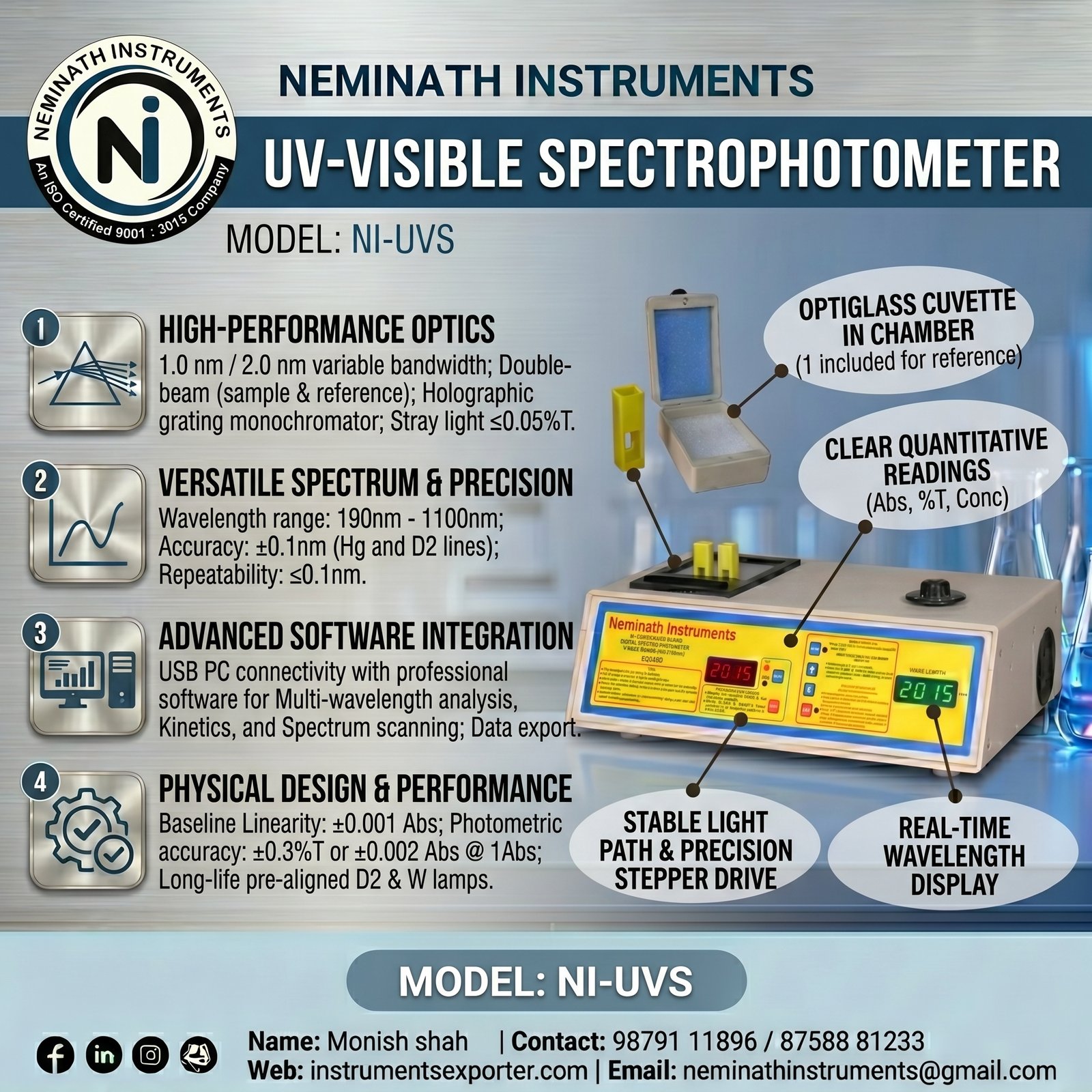
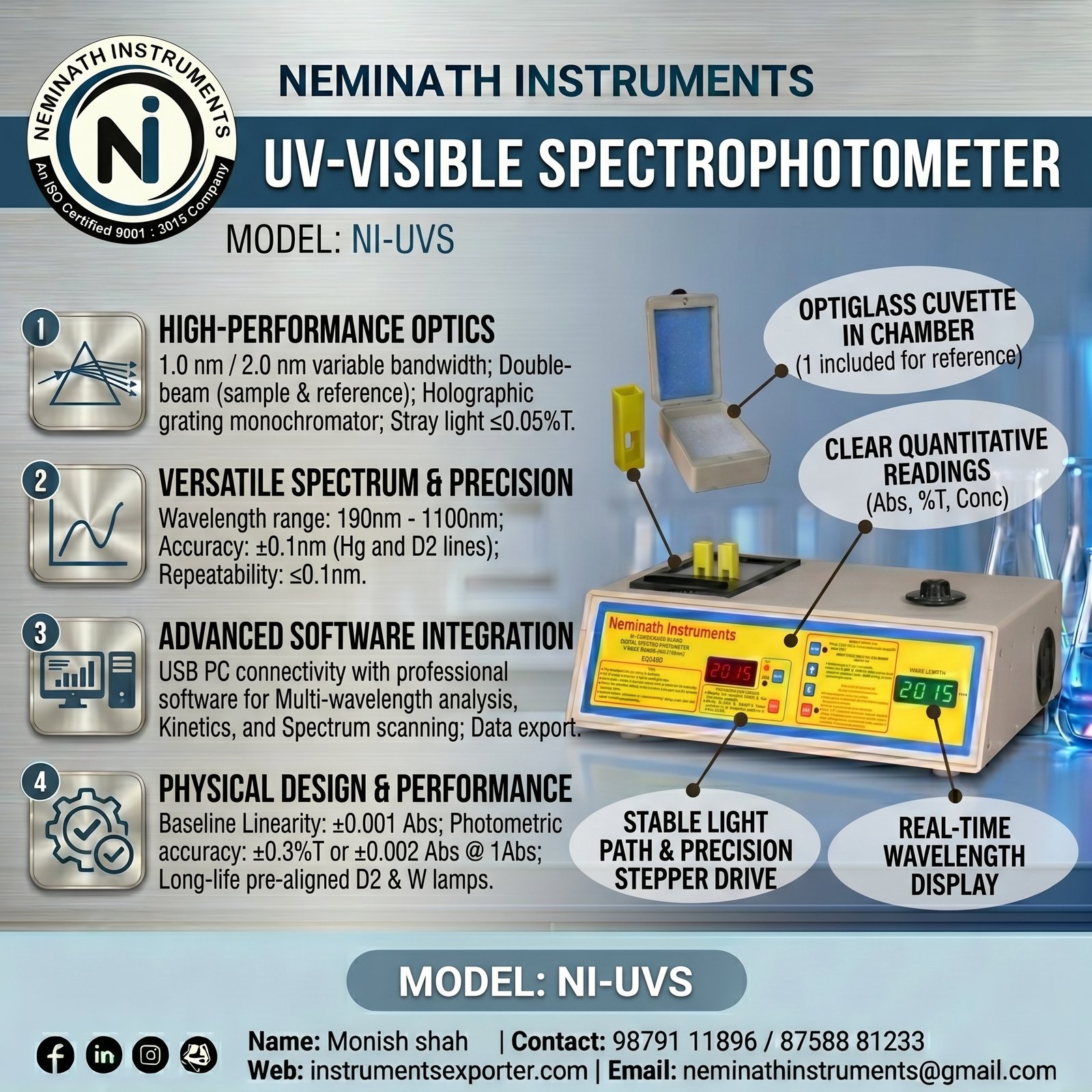
A UV–Visible spectrophotometer is an analytical instrument that measures the absorbance or transmittance of UV and visible light (190–900 nm) by a sample.
Working principle:
-
Light passes through the sample
-
Some wavelengths are absorbed
-
Detector measures transmitted light
-
Absorbance is proportional to concentration
Main components:
-
Light source (Deuterium + Tungsten lamp)
-
Monochromator (prism/grating)
-
Sample holder (cuvette)
-
Detector (photodiode/PMT)
-
Display/software system
-
4. Technical Specifications (Typical)
|
Parameter |
Specification |
|
Wavelength range |
190 – 900 nm (up to 1100 nm in some models) |
|
Optical system |
Single beam / Double beam |
|
Spectral bandwidth |
0.5 – 5 nm |
|
Wavelength accuracy |
±0.1 to ±0.3 nm |
|
Photometric range |
-4 to +4 Abs / 0–100% T |
|
Photometric accuracy |
±0.002 – 0.006 Abs |
|
Detector |
Silicon photodiode / PMT |
|
Light source |
Deuterium (UV), Tungsten (Visible) |
|
Stray light |
0.02% T |
|
Scanning speed |
Up to 3000 nm/min |
|
Interface |
USB / PC controlled |
|
Power supply |
220V, 50 Hz |
5. Apparatus is Supplied With
Typical supply includes:
-
Main UV–Vis spectrophotometer unit
-
Quartz cuvettes (10 mm path length)
-
Glass/plastic cuvettes
-
Dust cover
-
Power cable
-
Software + PC interface
-
User manual
-
Printer (optional in some systems)
-
UPS (in advanced setups)
6. Common Capacities Available
-
Single beam spectrophotometer
-
Double beam spectrophotometer
-
Microvolume spectrophotometer (for DNA/protein)
-
Scanning UV–Vis spectrophotometer
-
Portable/compact models
Sample capacity:
-
Standard cuvette: 1–3.5 ml
-
Multi-cell holder: 4–8 samples at once
7. Optional Accessories
-
Auto-sampler
-
Temperature-controlled cuvette holder (Peltier system)
-
Integrating sphere (solid sample analysis)
-
Flow cell accessories
-
Sipper system
-
Software upgrades for kinetics & biomethods
-
External printer & data storage devices
8. Dimensions & Weight (Approx.)
(Varies by model, typical laboratory unit)
-
Dimensions: ~ 800 × 600 × 450 mm
-
Weight: ~ 25 – 35 kg
-
Example: Packing size ~860 × 660 × 465 mm, weight ~35 kg